What is new in 1.2.0
Orion, the Ring and the nebulae you can fly into
Release 1.2.0 turned flat photographs of nebulae into shapes you can fly round, and says on every card what is measured and what is a drawing.
Release 1.2.0 · 27 October 2026 · about 4 minutes
A nebula on Space Radar used to be a photograph laid on the sky: true from where we stand, flat from anywhere else. Release 1.1.0 made the first four deep-sky objects into models, and release 1.2.0 added more nebulae: you can now fly round the Orion Nebula, look at the Ring Nebula from the side, and pass through the middle of a supernova remnant. This article says what you will see, and what is a measurement and what is a drawing, because on these pages that difference matters more than the picture.
Orion, as a blister
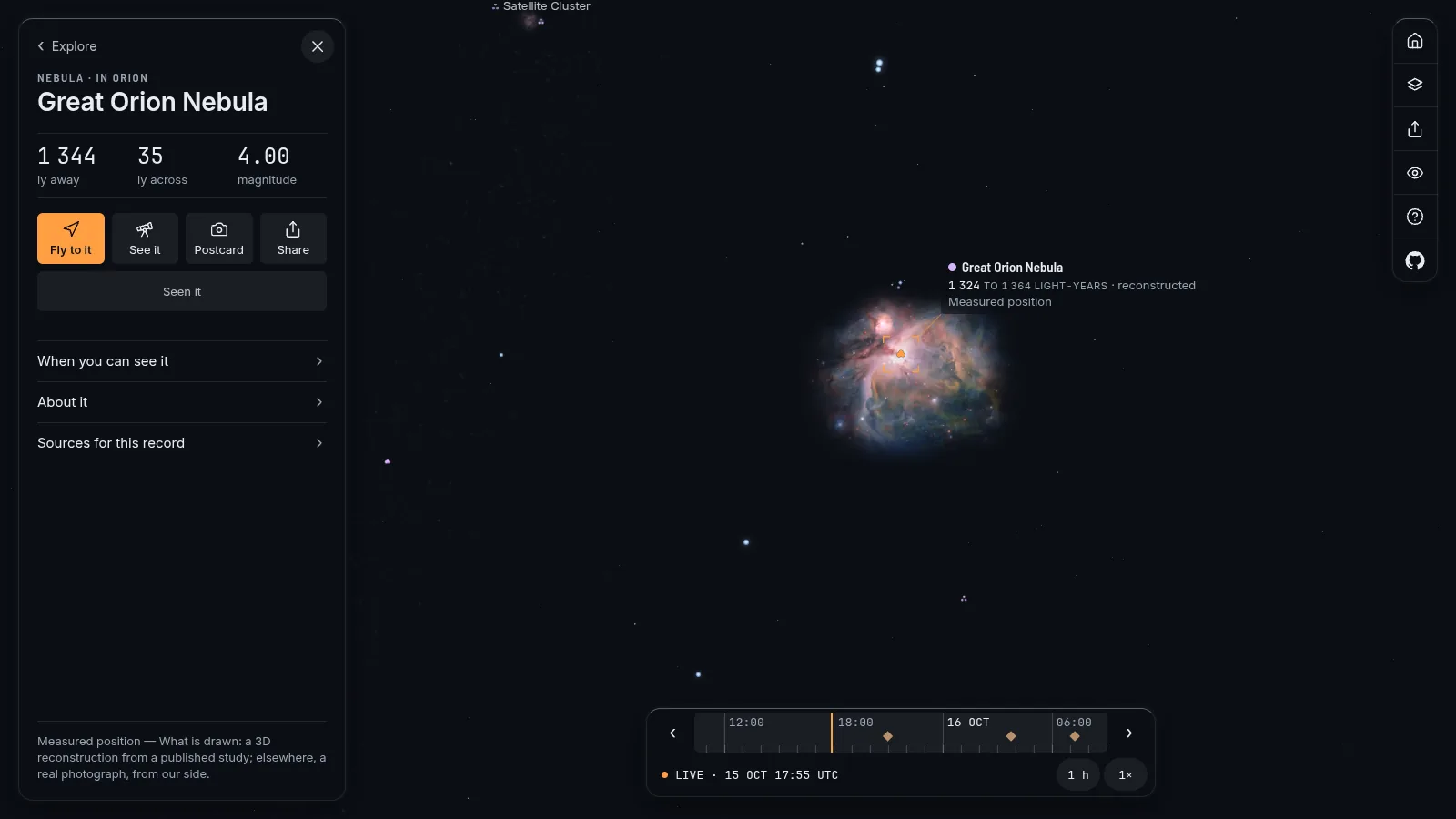
The Orion Nebula (M42) is 1,344 light-years away and about 35 light-years across. It is not a cloud floating free. It is the lit face of a much bigger dark cloud: the hot young stars of the Trapezium light a thin layer of gas on the cloud's near side, a layer shaped like a bowl, open toward us. Astronomers call it a blister.
Space Radar draws it that way. The light is the photograph, ESO's picture with its stars taken out, carried on a curved sheet at a reconstructed depth. Look from our side and the sheet and the picture are the same thing, which a test holds to within 5 percent. Turn the camera away and the sheet shows itself: the bowl, the bright bar where the surface turns toward us, the dark cloud behind it and, in front, the Veil of dust whose shadow is the Dark Bay.
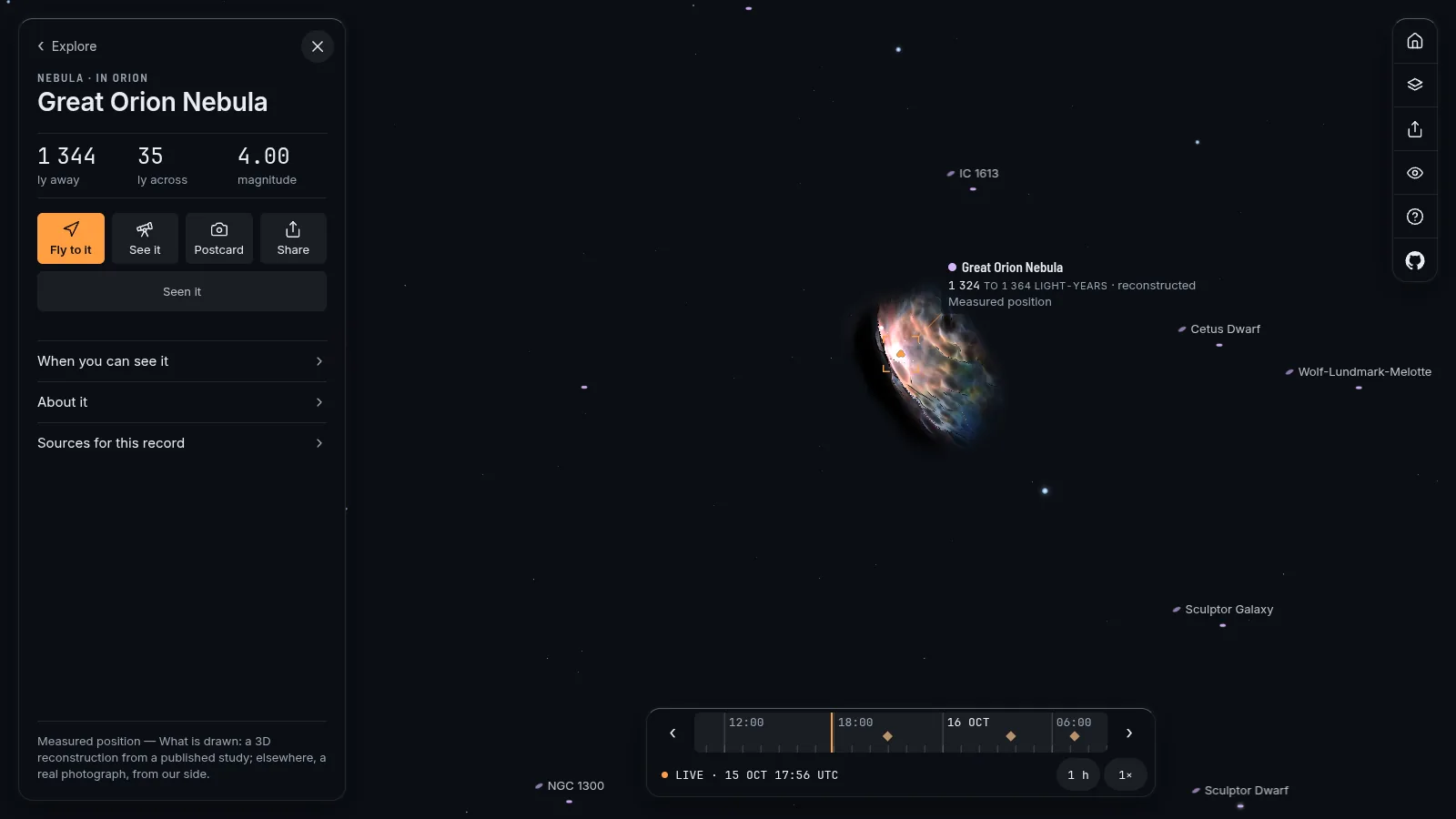
The Trapezium's four stars and the nearby star NU Ori sit where SIMBAD puts them on the sky, with their catalogued brightness. How far the main star stands in front of the lit gas is a published measurement, about 0.2 parsecs (O'Dell and others, 2009), and the Veil is 1 to 3 parsecs closer to us (Abel and others, 2004). Fly in close to the Trapezium and you are inside the bowl.
The Ring, along its axis
The Ring Nebula (M57) is a star that has thrown off its outer layers. Hubble's picture shows a ring; a 2013 study by C. R. O'Dell and colleagues finds that the ring is a thick, uneven disc seen almost face on, with two lobes of hotter gas pointing almost at us through the hole. Look at it from the side and the map shows exactly that: a disc, crossed by a spindle of blue light.
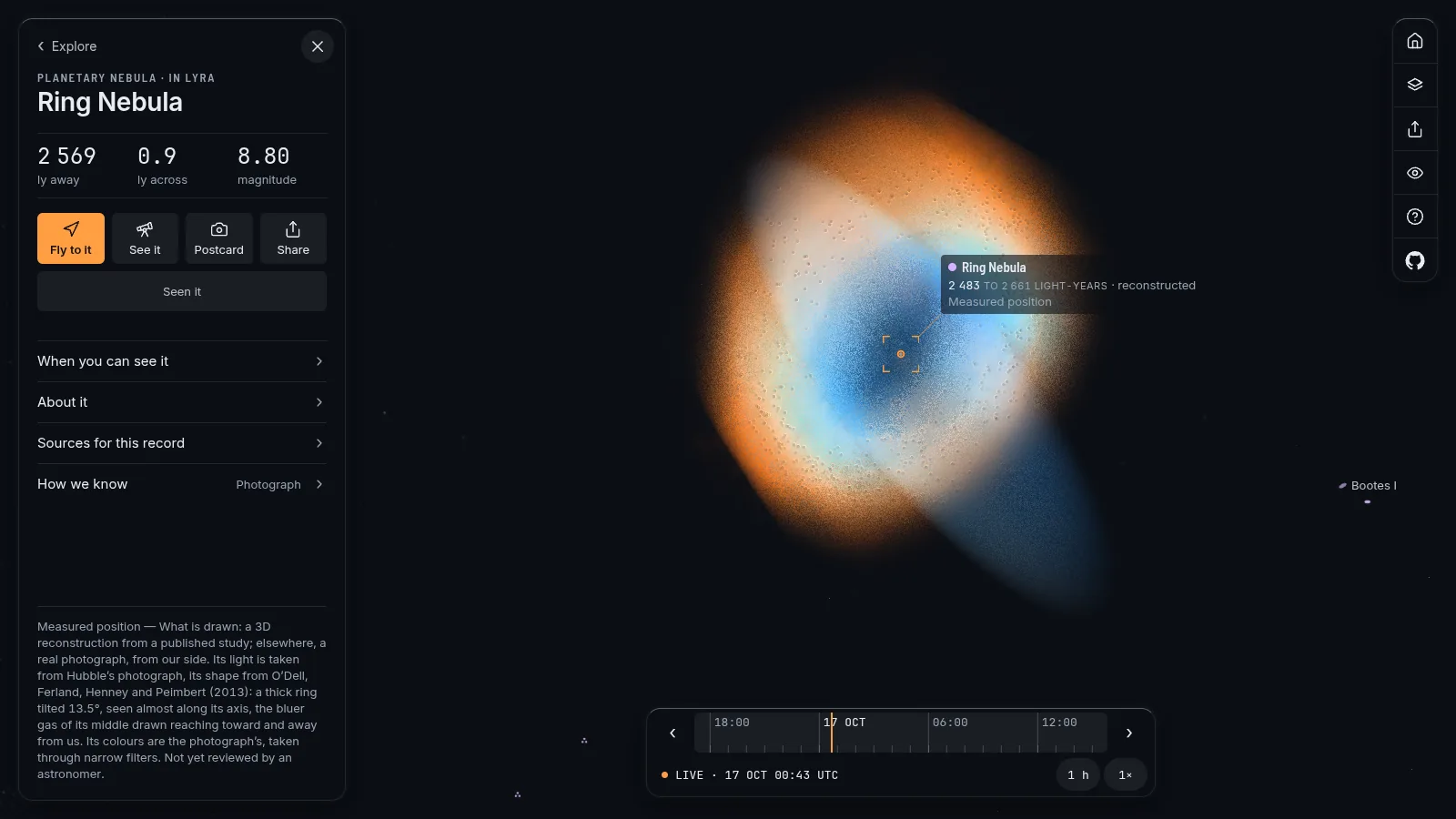
The Ring is 2,569 light-years away by Gaia's measurement of the central star's parallax, and 0.9 light-years across. Its white dwarf is drawn at 135,000 K, one value from the published fits. Where the map goes beyond the paper it says so: the disc's thickness and the lobes' shape are illustrations (the paper has no evidence about the lobes' form), and the outer halo and the arcs Webb found in it are not drawn at all.
Shells and sheets
A supernova remnant is a shell, not a sheet. The Veil Nebula, the Cygnus Loop, is 2,400 light-years away and 130 light-years across: the bright threads are where a blast wave from a star that exploded 10,000 to 20,000 years ago meets denser gas. Space Radar draws its photograph on a thin sphere, 37 parsecs across as Fesen and colleagues measured from Gaia parallaxes, and lets you go inside it. The paper allows the shell to be tilted by up to 20 degrees; the map does not draw the tilt.
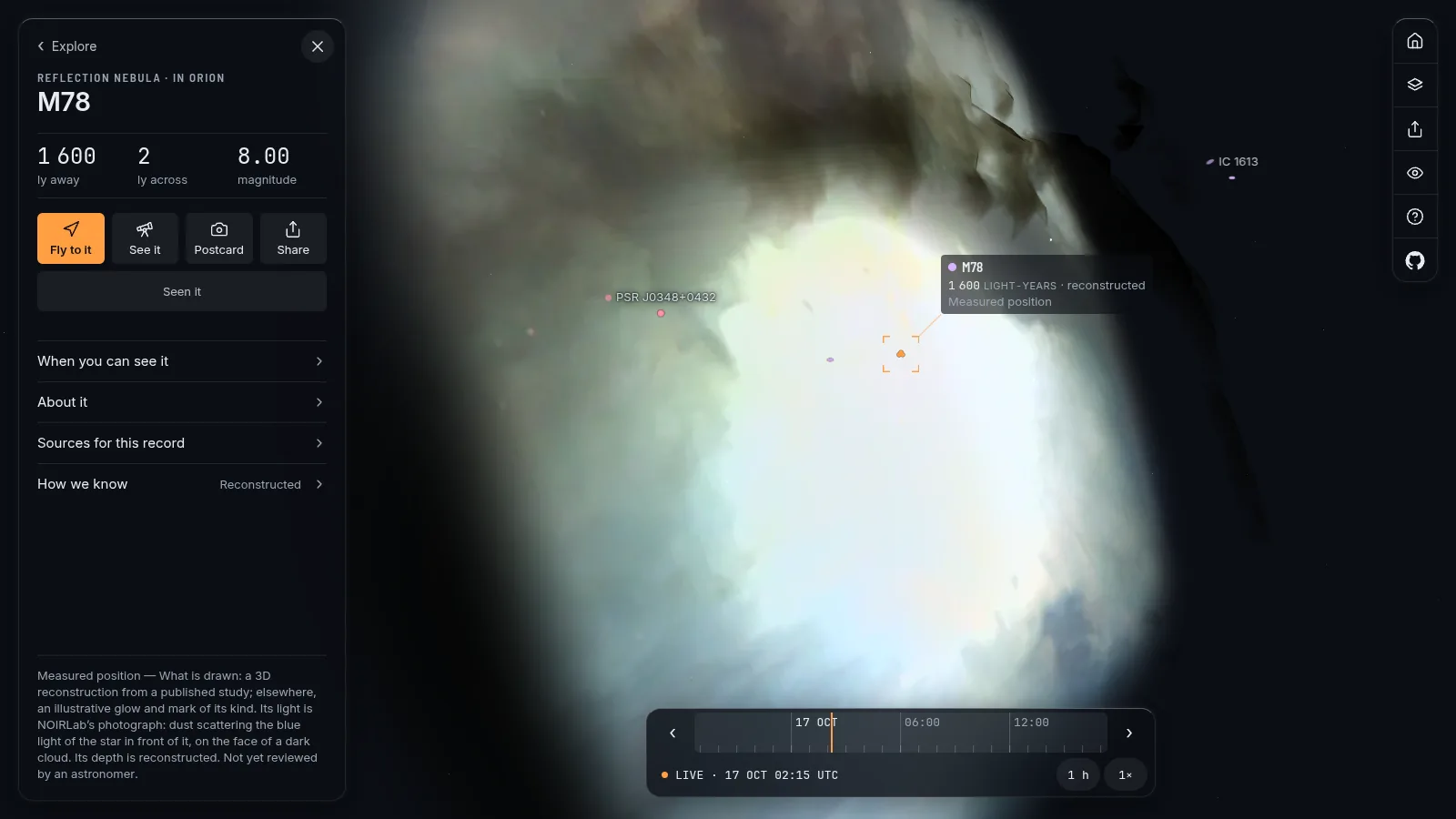
Dust gets its own treatment. The Horsehead Nebula is a pillar of dust in silhouette against glowing gas, and its dust here only absorbs: it dims and reddens what is behind it and adds no light of its own. M78 and the Iris Nebula are the opposite: dust that shines blue because a star beside it lights it. Their light changes as you turn, with the scattering modelled the way astronomers model dust in general.
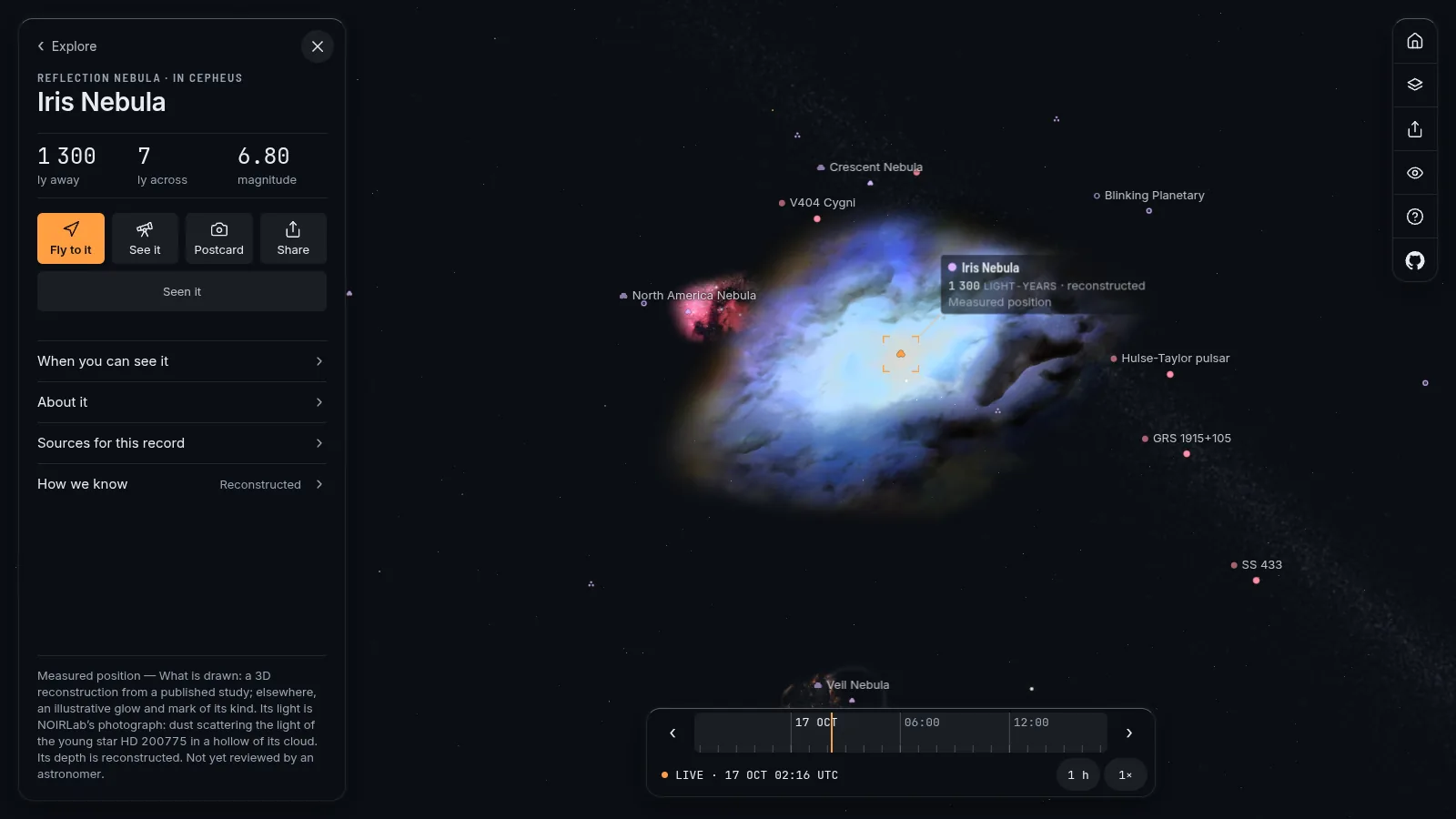
Measured, modelled, illustrative
Every one of these has a "How we know" row on its card. In short:
- Measured: the distance, where each star and each part of the picture sits on the sky, and the photograph's light.
- Reconstructed: how deep each layer is. From a published model where there is one, from the picture where there is not.
- Illustrative: the thickness of the layers, the cluster stars' places (a seeded sample, not a catalogue), and the strength of the glow, which is stretched so you can see it.
Each of these cards says in plain words that no astronomer has reviewed the model yet. Two more nebulae, the Crab and the Coalsack, were built for this release and held back by the maintainers on 17 October: turned, the Crab looked like a pale egg. The code stays, and the registry says why.
Fly there
On a phone, or when the frame rate drops, the map draws fewer steps and for the Horsehead falls back to the plain glow. Everything here works with no account and nothing to install.
Pictures and sources
The screenshots are of Space Radar itself (MIT licence), taken by a browser on a GitHub machine. The photographs under the models are ESO's Orion (ESO/G. Beccari), Hubble's Ring (NASA, ESA and C. Robert O'Dell, Vanderbilt University), and NOIRLab's M78 and Iris, all CC BY 4.0. Papers: Wen and O'Dell 1995, O'Dell and others 2009, Abel and others 2004, O'Dell and others 2013, Fesen and others 2018. Every row is in CREDITS.md.
More long reads
- Clusters you can fly into, and the edge of what we can see (release 1.2.0)
- The Moon at a low Sun, the giants' rings and the plumes (release 1.2.0)
- Spacecraft that look like themselves (release 1.3.0)
- Galaxies, Carina and the Magellanic Cloud from their own numbers (release 1.3.0)
- All the long reads