What is new in 1.5.0
Arrokoth, Kleopatra and nine more small worlds in their own shapes
Release 1.5.0 replaces the generic rock with the shapes spacecraft and radar measured for eleven small bodies, and says on every card what was seen.
Release 1.5.0 · 30 October 2026 · about 4 minutes
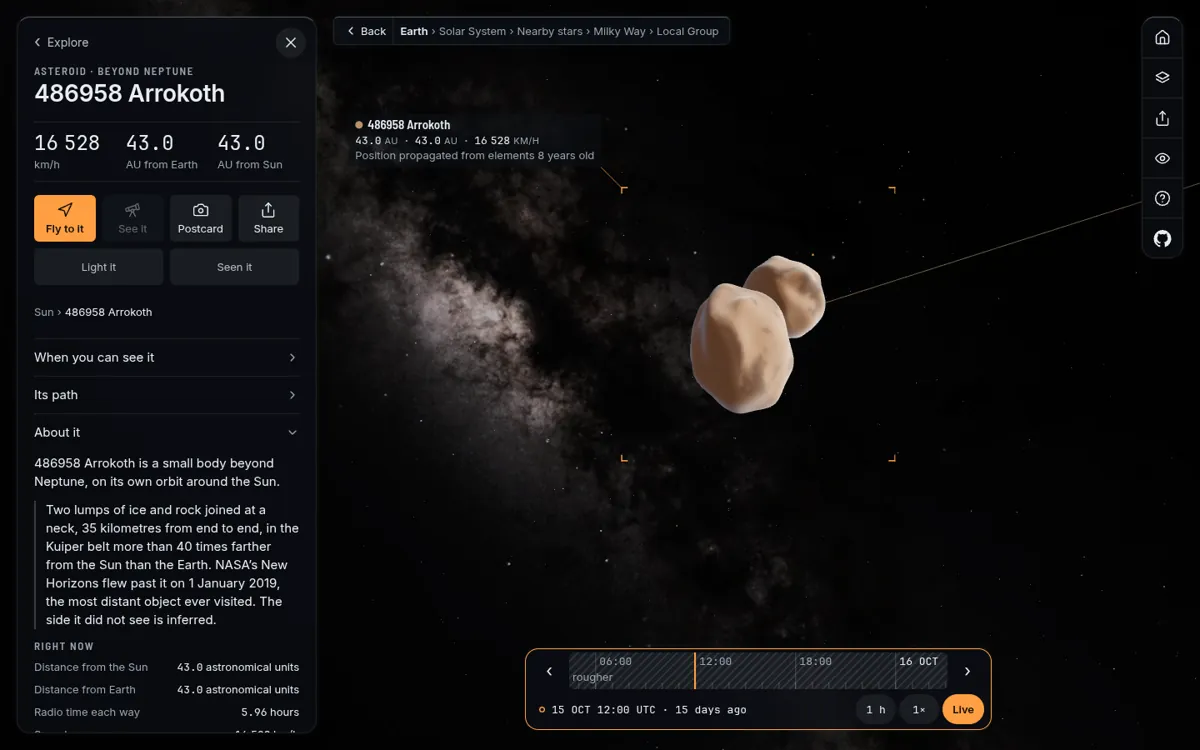
Release 1.5.0 gives eleven small bodies of the Solar System the shapes that spacecraft and radar actually measured. Select one of them on the map and fly close, and the generic grey rock is replaced by a published shape model: Arrokoth's two lobes, Kleopatra's dog bone, the contact binary 1996 HW1. Each sits on its own orbit from JPL, and each card says what was seen and what was filled in.
The eleven
Five come from the missions that flew past them. Arrokoth is New Horizons' target beyond Neptune, the most distant object a spacecraft has visited, two lumps of ice and rock joined at a neck about 35 kilometres from end to end. Donaldjohanson is the main-belt asteroid NASA's Lucy flew past in April 2025, named for the discoverer of the Lucy fossil that the mission is named after; its shape is DLR's, from Lucy's pictures. The comet 67P/Churyumov-Gerasimenko and the asteroids Lutetia and Steins come from Rosetta.
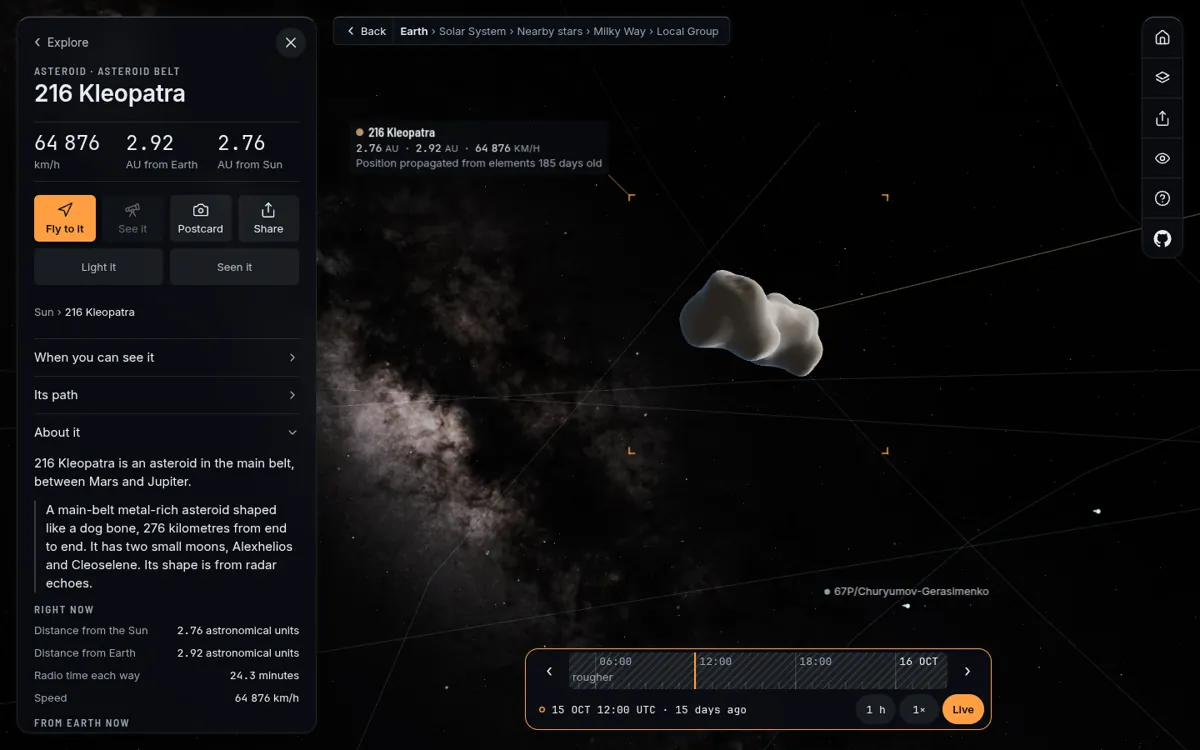
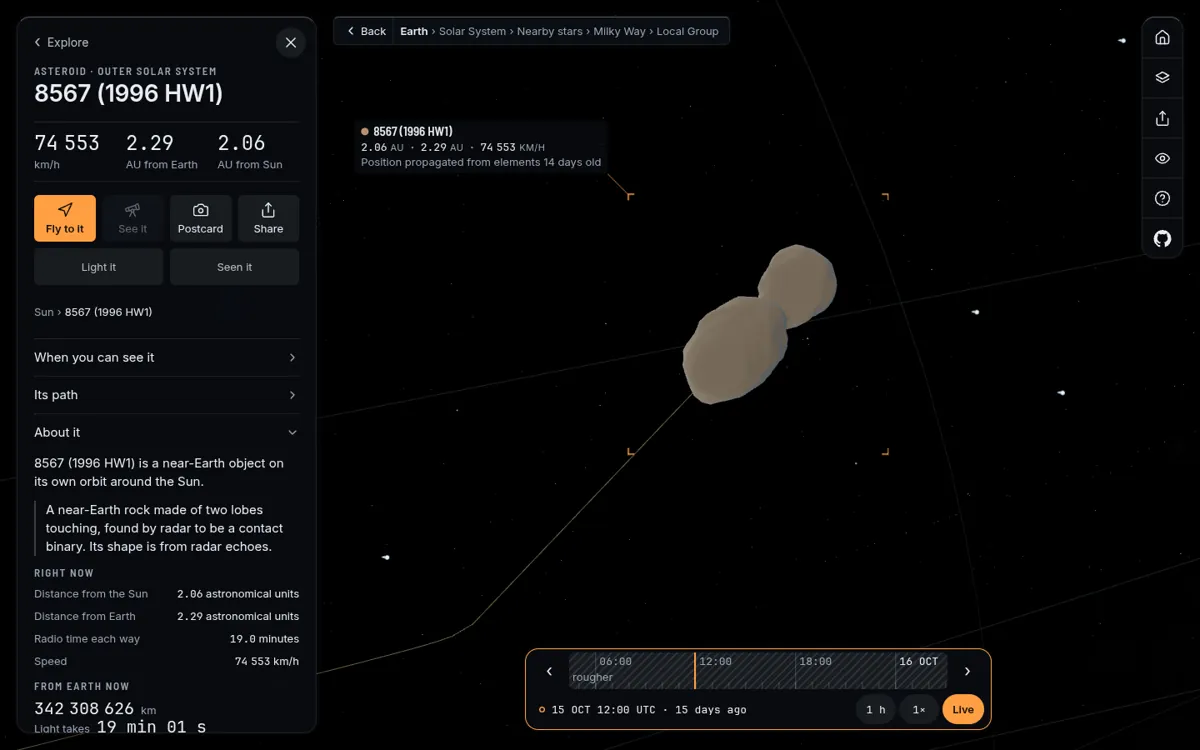
Six come from radar. Toutatis, Geographos, Kleopatra, Mithra, Golevka and 1996 HW1 were never visited; their outlines were worked out from the echoes of radio pulses sent from Earth by planetary radar teams; Toutatis's model, for one, is Hudson and Ostro's from Goldstone. The models are the ones NASA publishes for 3D printing.
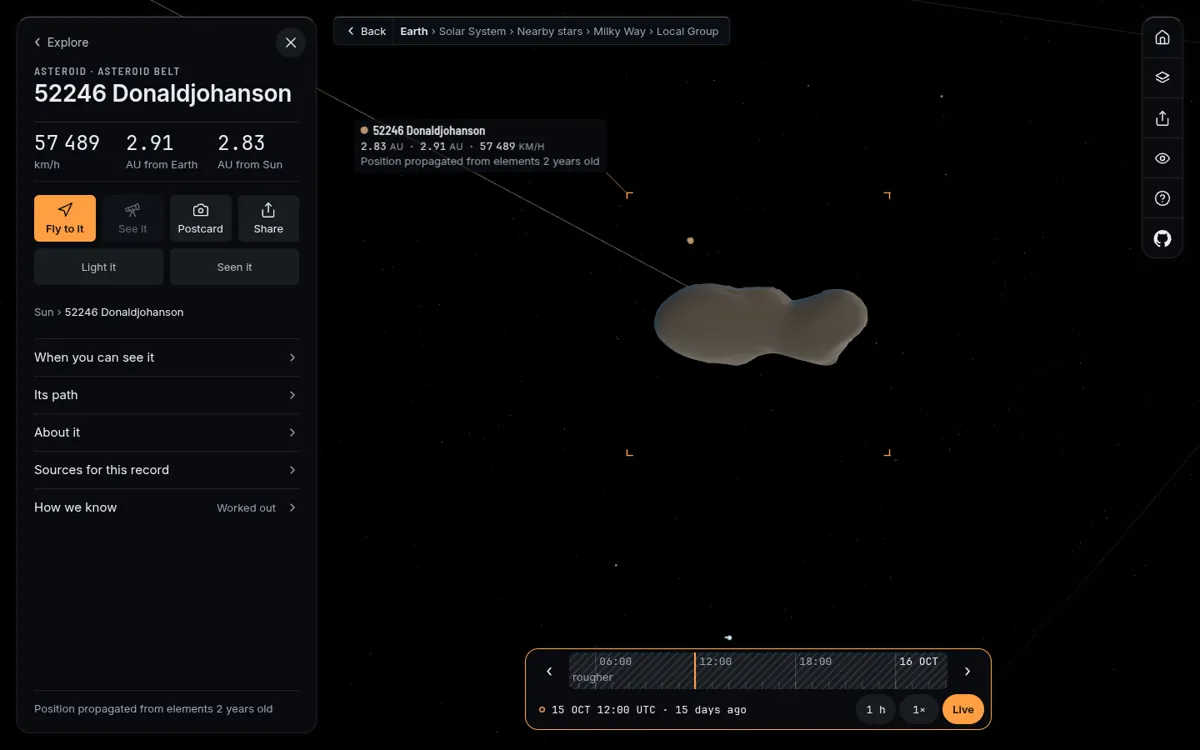
None of these ten asteroids was a place on the map before this release. The map drew a generic rock only for what JPL's close-approach table held that week, and 67P was one dot among the comets.
Grey from albedo, relief from the source
The colour of each body is not chosen by eye. Its grey follows its measured albedo, the fraction of light it reflects, through one rule for all eleven, with a tint of the same lightness for its spectral type. The albedo and its reference are written in each body's row of the registry. Arrokoth's is the published 0.21 and 67P's the published 0.065, which is why the comet looks so much darker than the asteroids beside it.
Where a model had to be simplified to load quickly in a browser, the full-resolution model's surface detail was baked into a normal map inside the file, so the craters and ridges you see are the source's own and nothing is invented. Arrokoth keeps its published brightness map, softened, and its red is a modelled approximation of New Horizons' colour.
Why it was hard
Shape models come in many formats and sizes. Rosetta's full 67P model has 788 000 plates; the browser gets 40 000 with the rest of the detail carried in the normal map, and the file arrives only when you select the comet and come close. The turning was the other problem. The mission bodies turn at the pole and rate their datasets give. The radar bodies do not turn at all, because their files state no axes, and their cards say so rather than inventing a spin.
How to try it
Search the map for a name, or open one directly:
- Arrokoth, beyond Neptune
- Kleopatra, in the main belt
- Donaldjohanson, visited by Lucy
- 1996 HW1, a near-Earth contact binary
Press "Fly to it", then drag to turn round the body. "About it" on the card says how its shape was made.
Measured, modelled, reconstructed
- Measured: the outlines, the poles and rotation rates of the mission bodies, and the orbits, which are held to JPL Horizons within 0.0002 au by the project's tests.
- Modelled: the grey, from one rule on the albedo; the tint, from the spectral type; and the phase of every turn, which no source gives for a chosen day.
- Reconstructed: the sides that no camera saw. Lutetia, Steins, Donaldjohanson and Arrokoth were each imaged from one side as the spacecraft went by, and their cards say which part is inferred.
The radar shapes are smooth at this size, from 3 000 to 13 000 plates each: recognisable, but plain. About 54 more radar shapes, and Halley, Gaspra, Ida and Mathilde, wait on a server that refused the project's build machine. The Rosetta datasets for 67P, Lutetia and Steins state no licence, and whether to keep them is still an open question for the owner.
Pictures and sources
Screenshots of Space Radar 1.5.1 (MIT licence) from the project's look workflow, probe r15-b1. Arrokoth's shape and albedo map: Porter (2024), New Horizons LORRI data, NASA Planetary Data System (CC0). Donaldjohanson: DLR, NASA NAIF Lucy SPICE bundle (CC0). Radar shapes: NASA 3D Resources (public domain). The shapes were prepared by Sara-Agent, the project's agent, in pull request 1309; every row is in CREDITS.md.
More long reads
- Moments: a mission replayed in 3D on one clock (release 1.5.0)
- Stars with no distance, 4 383 pulsars and the farthest galaxy (release 1.5.0)
- Eight nebulae as walls of glowing gas, dust and stars (release 1.4.0)
- Black holes in 3D, sized to the Event Horizon Telescope (release 1.4.0)
- Sixty more craft with shapes of their own (release 1.4.0)
- Orion, the Ring and the nebulae you can fly into (release 1.2.0)
- Clusters you can fly into, and the edge of what we can see (release 1.2.0)
- The Moon at a low Sun, the giants' rings and the plumes (release 1.2.0)
- Spacecraft that look like themselves (release 1.3.0)
- Galaxies, Carina and the Magellanic Cloud from their own numbers (release 1.3.0)
- All the long reads