
What is new in 1.9.0
RADARSAT-2, COSMO-SkyMed, GOSAT and five more Earth watchers in their own shapes
Release 1.9.0 replaces the generic radar blade, weather box and telescope tube with models of eight kinds of satellite, built from their published sizes.
Release 1.9.0 · 6 November 2026 · about 4 minutes
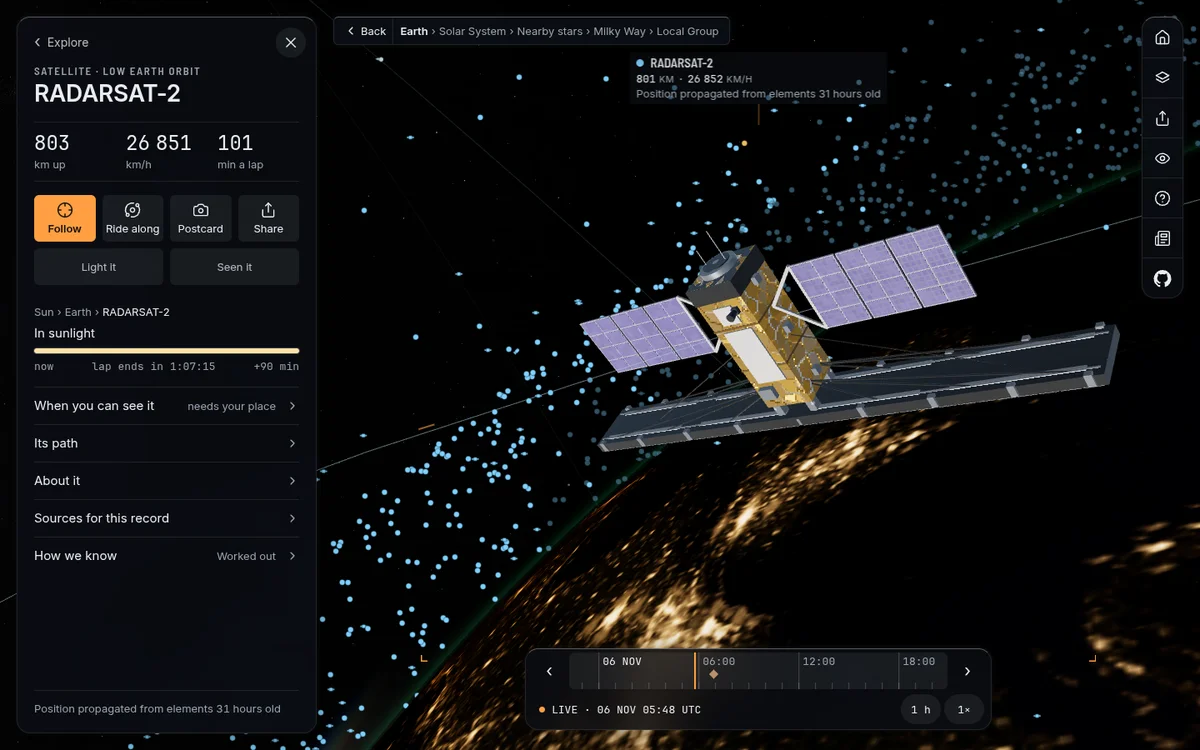
Release 1.9.0 gives eight kinds of Earth-watching satellite a model of their own. RADARSAT-2, the three satellites of the RADARSAT Constellation Mission, COSMO-SkyMed in both its generations, Elektro-L, AstroSat, GOSAT (Ibuki) and MicroCarb used to wear a stand-in: a generic radar blade, a generic geostationary box or a generic telescope tube. Select one now and you see the craft itself, built in code from published dimensions and from pictures read for the layout.
The radar satellites
Radar satellites see the ground through cloud and at night by sending out microwaves and timing the echoes, and the antenna is most of what they are. RADARSAT-2, Canada's, is a gold bus 3.7 m high standing on the back of a 15 m antenna of four panels, with two three-panel wings along it. The RADARSAT Constellation Mission that followed it is three smaller craft, each a box on a 6.88 m antenna in two halves, with four ship-tracking whips and one solar array leaning from its side. They used to share one file; now they are two.
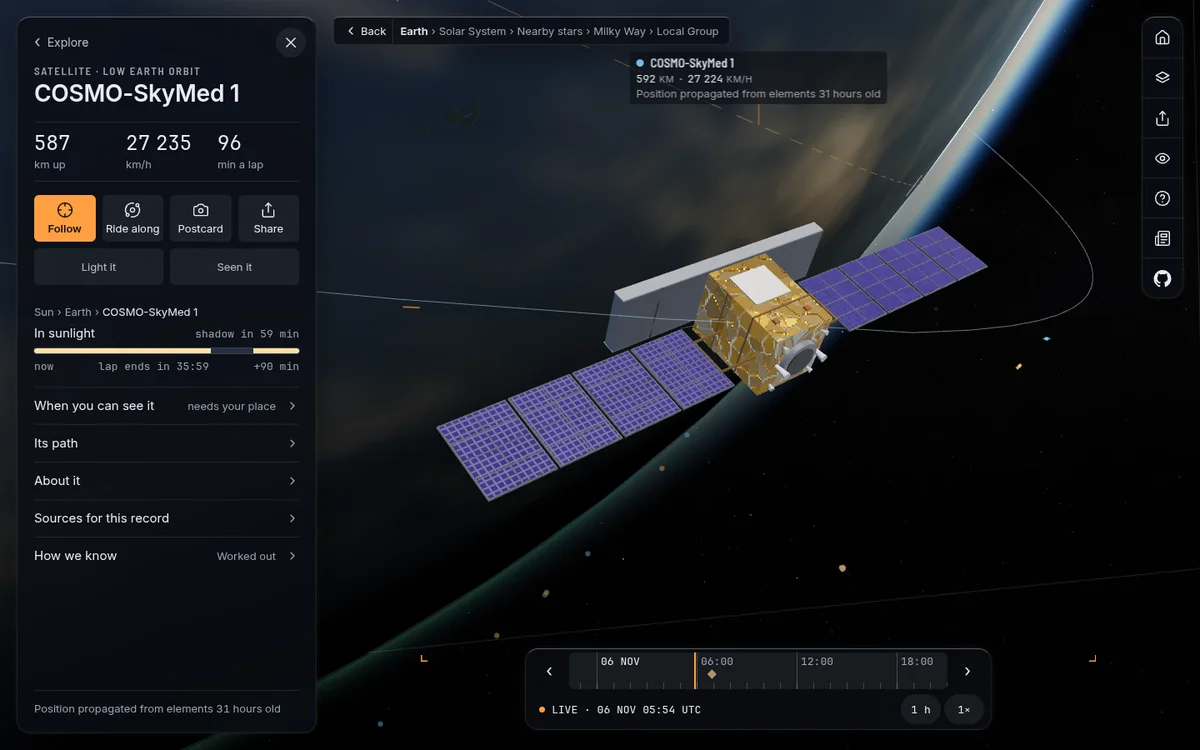
Italy's COSMO-SkyMed is two generations as well. The first, four satellites, is a gold box with a 5.7 m by 1.4 m antenna of forty tiles on its Earth end and two four-panel arrays, 18.3 m² in all. The second, CSG-1, -2 and -3, is a taller bus with a payload module, a bronze-faced antenna of ten macro-tiles and arrays on hexagon-cut frames.
Weather and climate
Elektro-L 2 to 5, Russia's geostationary weather satellites, are an eight-sided black body under a white Earth deck with the two scanner units, a data-collection helix and two dishes, and one solar wing of three panels. GOSAT (Ibuki), Japan's greenhouse-gas satellite, is JAXA's 3.7 by 1.8 by 2.0 m body with two gold boxes, the hood of its TANSO-FTS spectrometer and two paddles 13.7 m from tip to tip. MicroCarb, France's small carbon-dioxide mapper, is a 0.6 by 0.8 by 1.0 m Myriade Evolutions platform with a silver optical housing and the oval baffle of its cold radiator.
And one telescope
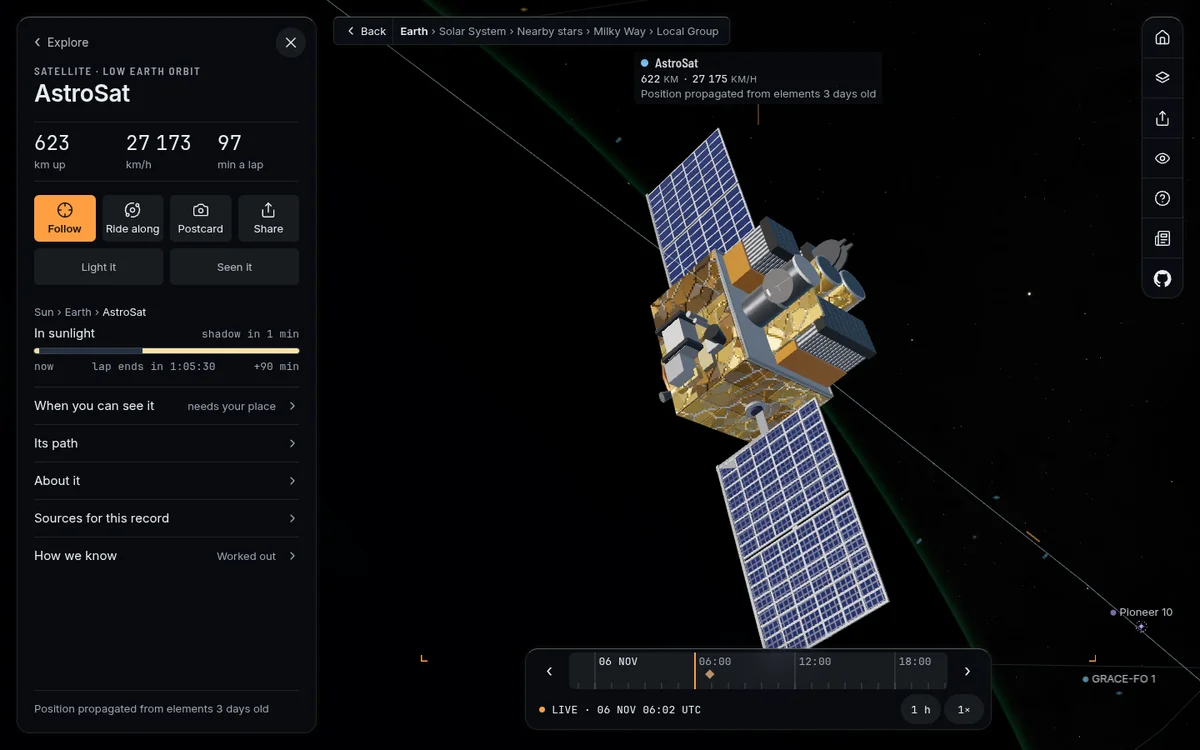
AstroSat, India's multi-wavelength observatory, is a gold bus 1.96 by 1.75 by 1.30 m carrying three LAXPC X-ray units, two gold ultraviolet tubes, the soft X-ray telescope with its door, the CZTI imager and two sky monitors, on four panels 8.5 m tip to tip. It now flies with its instruments looking away from the Earth and its cells turned to the Sun, as the real drive turns them.
Why it matters
These are the satellites that measure flooding through cloud, carbon dioxide over a continent and the weather over Russia, and on most maps they are a dot with a number. A model built from their own dimensions lets you see what kind of machine does that job: why a radar craft is mostly antenna, why a greenhouse-gas satellite carries a spectrometer hood. Each model is 17,000 to 19,000 triangles and loads only when you select its craft.
How to try it
Open one, press "Fly to it" and drag to turn round it:
The card under "About it" says "shape built from published dimensions and pictures; details simplified", and "Sources for this record" lists what was cited.
What was hard
Agencies publish the size of an antenna far more often than the size of a bus. For RADARSAT-2, COSMO-SkyMed's antenna and tile counts, GOSAT and AstroSat the main sizes are cited. For the RCM's bus, COSMO-SkyMed's bus and wings and the second generation's arrays, no page gives a size in metres, so they were read off the agencies' drawings, scaled by the one cited length. Elektro-L's only cited size is its wing, 8.17 m²; everything else was read off photographs of a 1:5 model by that wing. Where a size had no source the model was not built: Fengyun-4, CFOSAT, FLEX and Capella's Acadia craft stay on their stand-ins, and the release notes say why for each.
Measured, modelled, reconstructed
- Measured: the cited sizes (antennas, tile counts, array areas, body boxes), the orbits from the public catalogue and each craft's NORAD number.
- Modelled: the pose. Each radar antenna is drawn looking straight down, although the real craft look to one side; Elektro-L's wing turns once a day.
- Reconstructed: every part read off a drawing or a photograph rather than a page, and the blankets, drawn as quilted patches rather than crumpled foil. MicroCarb's array size is an estimate, and no model has yet been checked by someone who knows the craft.
Pictures and sources
Screenshots of Space Radar 1.9.0 (MIT licence) from the project's look workflow, probe model, run 42169991360. Dimensions: ISRO, JAXA, CNES, the CSA, ASI and eoPortal, listed per craft in registry/models.yaml. The models were built by Sara-Agent, the project's agent, in release 1.9.0 from public requests 959, 961, 970, 980, 981 and 997; every row is in CREDITS.md.
More long reads
- Fourteen new Lab simulators: orbits, clocks, stars and the habitable zone (release 1.9.0)
- Pan, Atlas, Hyperion and eight more of Saturn's small moons in their Cassini shapes (release 1.9.0)
- Moments: a mission replayed in 3D on one clock (release 1.5.0)
- Arrokoth, Kleopatra and nine more small worlds in their own shapes (release 1.5.0)
- Stars with no distance, 4 383 pulsars and the farthest galaxy (release 1.5.0)
- Eight nebulae as walls of glowing gas, dust and stars (release 1.4.0)
- Black holes in 3D, sized to the Event Horizon Telescope (release 1.4.0)
- Sixty more craft with shapes of their own (release 1.4.0)
- Orion, the Ring and the nebulae you can fly into (release 1.2.0)
- Clusters you can fly into, and the edge of what we can see (release 1.2.0)
- The Moon at a low Sun, the giants' rings and the plumes (release 1.2.0)
- Spacecraft that look like themselves (release 1.3.0)
- Galaxies, Carina and the Magellanic Cloud from their own numbers (release 1.3.0)
- All the long reads
From the journal
Methanimine on Titan: ALMA Finds a Molecule Cassini Could Only Guess At
ALMA has detected methanimine (CH2NH) in the atmosphere of Saturn’s moon Titan, a step on the chemical road to amino acids. What was found and what it means.
Space Radar Video: Narrated Flights to the Moon, Voyager 1 and TRAPPIST-1
Watch Space Radar’s narrated space films, from the Moon to Voyager 1 and on to TRAPPIST-1, with chapters, full transcripts and a player that does not track you.
How the Night Sky Changes Over 10,000 Years, and How to Catch Algol Dimming
Do stars move? Watch proper motion and precession reshape the sky over 10,000 years, and learn when Algol dims, with 58 variable stars that follow the clock.
Every story in the Space Radar journal (in English)